
Shape and corners
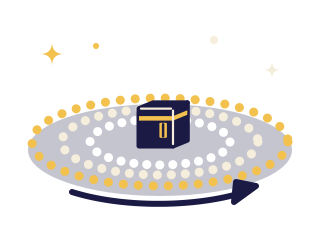
The Kaaba is built of grey granite blocks and is not quite a perfect cube: its sides are of slightly different lengths, and published measurements vary depending on whether they include the marble base. Its four corners carry traditional names after the lands they face. The eastern corner holds the Black Stone. The southern corner is the Yemeni corner, al-Rukn al-Yamani, which pilgrims touch with the right hand during tawaf if they can reach it, without kissing it. The other two are the Iraqi and the Syrian corners.
The single door, made of gold-covered panels installed in 1979, sits about two metres above the ground on the north-east wall and is reached by a wheeled staircase when the Kaaba is opened. On the north-west side, a gold rain spout, the mizab, drains the roof into the area of the Hijr Ismail. The interior is plain, with marble floors and walls, three wooden pillars supporting the roof, and hanging lamps; it is opened for washing by invited dignitaries and is closed to pilgrims.
The Black Stone
The Black Stone, al-Hajar al-Aswad, is set into the eastern corner of the wall, its broken fragments held together in a silver frame. Islamic tradition connects it with the building of the Kaaba by Ibrahim and Ismail, and the Prophet kissed it during his pilgrimage. Tawaf starts and ends on the line level with it, marked today by a green light on the mosque wall opposite the corner; the marble line that once crossed the floor was removed because pilgrims stopped on it.
Kissing or touching the Stone is recommended, not required. When the crowds are dense, scholars advise pilgrims to raise the right hand towards it from a distance instead, as pushing and harming others outweighs the merit of touching it. The caliph Umar's words, that he kissed it only because he had seen the Prophet do so, are often quoted to explain that the Stone has no power of its own.
Hijr Ismail and the Multazam
Opposite the north-west wall stands a low, semicircular marble wall enclosing the Hijr Ismail, also called the Hatim. Part of the space inside was within the Kaaba as originally built by Ibrahim; when the Quraysh rebuilt it a few years before the start of the Prophet's mission, they ran short of lawful funds and left this section out. For that reason tawaf must pass outside the semicircle, and praying inside it is regarded by many as praying inside the Kaaba. It can be entered at quieter times.
The Multazam is the stretch of wall, about two metres long, between the Black Stone and the door. Pilgrims cling to it in supplication when they can reach it, following reports of the Prophet's companions doing so. In busy periods this is rarely possible without crushing, and a dua made anywhere in the mosque is no less heard.
The kiswah
The Kaaba is draped in the kiswah, a black silk covering with verses of the Quran woven into it and a band of gold and silver embroidery about two-thirds of the way up. A separate embroidered curtain, the sitarah, hangs over the door. The kiswah is made each year at the King Abdulaziz Complex for the Holy Kaaba Kiswa in Makkah.
For centuries the kiswah was replaced during Hajj, on the Day of Arafah. Since 1444 AH, in July 2022, it has been changed on the night of 1 Muharram, the Islamic new year: because the Islamic day begins at sunset, the work starts after the night prayer on the evening before the Gregorian date and runs into the early hours. During the Hajj season the lower part of the kiswah is usually raised and covered with white cloth to protect it from damage, which is why the Kaaba looks different in photographs taken at that time.
Rebuilt through history
Muslims believe the Kaaba was raised by Ibrahim and his son Ismail, an account told in the history of Hajj. The Quraysh rebuilt it around the year 605 after fire and flood damage; according to the biographies, the Prophet, still years before his mission began, settled a dispute between the clans over who should set the Black Stone back in place. After damage in the siege of 683, Abdullah ibn al-Zubayr rebuilt it to include the Hijr, but after the Umayyads retook Makkah it was restored in 693 to the Quraysh plan, the shape it keeps today. It was rebuilt again under the Ottoman sultan Murad IV after floods in the early seventeenth century, and has been repaired and restored many times since.
To see how the Kaaba fits into the wider mosque, read our guide to Al-Masjid al-Haram; for walking around it, see the page on tawaf; and for the sanctuary's place in the city's past, the history of Makkah.
Sources
- Encyclopaedia Britannica: Kaaba
- The National: Covering of Kaaba changed to mark Islamic new year (2022)
- Wikipedia: Kaaba
Page updated 2026-11-21